
Learn About Persian Rugs




Persian Village Rugs: The Enduring Beauty of Hamedan Weaving
Persian Village Rugs: The Enduring Beauty of Hamedan Weaving
When people imagine a Persian rug, they often picture the highly detailed floral carpets woven in famous cities such as Isfahan, Kashan or Tabriz. However, some of the most distinctive, durable and warmly admired Persian rugs originated far from formal city workshops. They were woven in small villages, often inside family homes, by craftspeople who inherited their knowledge from earlier generations.
Known as Persian village rugs, these handmade pieces are celebrated for their strong wool, expressive patterns and individual character. Slight variations in colour, proportion and design are not considered faults. They are evidence that the rug was created by hand rather than reproduced from a factory template.
Among Iran’s important village-weaving regions, Hamedan holds a special place. Rugs from Hamedan and its surrounding villages have furnished homes for generations and remain popular with collectors, decorators and families seeking an authentic handmade rug for everyday use.

What Is a Persian Village Rug?
A Persian village rug is a hand-knotted rug woven in a settled rural community rather than in a large urban workshop or by a fully nomadic tribe. Traditionally, weaving could take place inside the weaver’s home, with skills passed between family members and designs influenced by the customs of the surrounding district.
City workshops were more likely to work from detailed plans prepared by specialist designers. Village weavers often followed familiar patterns from memory, adapting them as they worked. This allowed greater freedom and produced rugs with a less formal, more personal appearance.
Common characteristics of Persian village rugs include:
- Hand-knotted construction using traditional techniques
- Durable wool pile suited to regular household use
- Geometric medallions and stylised floral motifs
- Strong reds, blues, ivory, brown and natural wool tones
- Small variations in pattern, colour and symmetry
- Design traditions associated with a particular village or district
There is no single design that defines every village rug. Iran contains numerous weaving regions, and neighbouring communities can produce recognisably different patterns, structures and colour combinations.

Hamedan: A Centre of Persian Village Weaving
Hamedan is an ancient city and province in western Iran, surrounded by mountainous countryside and numerous towns and villages. The wider region became an important centre for collecting, trading and distributing handmade rugs woven in surrounding communities.
For this reason, the term Hamedan rug can describe a broad family of rugs rather than one completely uniform style. Many rugs reached the market through Hamedan even when they had been woven in a smaller settlement elsewhere in the province.
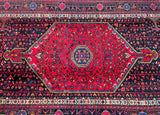
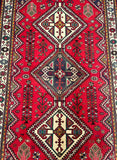
Hamedan rugs are commonly recognised for practical construction, wool pile and lively village patterns. Diamond-shaped central medallions are frequent, although all-over Herati designs, floral forms, vines, leaves and geometric borders are also found.
The palette varies between districts, but traditional examples often feature madder-inspired reds, dark indigo or navy blue, ivory, brown, camel, soft blue and touches of green or gold. Age, washing, wool quality and dye variations can give older pieces a particularly warm and harmonious appearance.
Important Rug-Weaving Areas Around Hamedan
Numerous villages and towns are connected with the wider Hamedan weaving tradition. Names and attributions can vary in the international rug trade, particularly when older pieces were purchased through regional markets. Nevertheless, several weaving areas are especially well known.
Malayer
Malayer rugs range from bold village pieces to relatively fine and detailed examples. They may display central medallions, all-over floral arrangements or repeated Herati patterns. Antique Malayer rugs are particularly appreciated for their elegant drawing, beautifully aged colours and balance between rustic character and refinement.

Nahavand
Nahavand rugs are often substantial and visually confident. Many feature a strong central medallion surrounded by floral forms, leaves or angular vines. Deep reds and dark blues are common, and the sturdy wool pile makes many Nahavand rugs suitable for living rooms and other frequently used areas.

Hosseinabad
Hosseinabad rugs are frequently associated with repeating Herati-style patterns composed of flowers, leaves and diamond forms. The repeating field makes these rugs versatile in both traditional and contemporary rooms. Hosseinabad runners are also popular because their continuous patterns work naturally in hallways.
Tuyserkan
Tuyserkan rugs may feature angular medallions, geometric flowers and strongly defined borders. Their designs often have the spontaneous drawing associated with village weaving, giving them warmth without appearing overly formal.

Mehraban
Mehraban rugs are known for strong construction and geometric interpretations of floral designs. Depending on age and origin, examples may display dark blue fields, rich reds, warm brown tones and bold medallions.
Borchalou and Ingelas
Rugs attributed to Borchalou or Ingelas can be less commonly encountered than general Hamedan pieces. They are admired for distinctive local drawing, harmonious colours and the individuality sought by collectors of Persian village weaving.
The Connection Between Village and Tribal Rugs
The boundary between village rugs and tribal rugs is not always absolute. Communities moved, tribes settled, families intermarried and patterns travelled between neighbouring groups. As nomadic or semi-nomadic families established permanent settlements, they often continued weaving designs rooted in tribal tradition.
Tribal rugs were traditionally created by mobile or semi-mobile communities, sometimes using portable horizontal looms. Settled village weavers could use more permanent looms and had easier access to established local markets. Their rugs could consequently become larger or more structurally consistent while retaining bold tribal geometry and symbolic motifs.
This cultural connection explains why some village rugs have the energetic appearance of tribal weaving but a construction associated with a settled community. Rather than belonging to completely separate artistic worlds, tribal and village rugs form part of a continuing and interconnected weaving tradition.
Village Rugs, Tribal Rugs and City Rugs Compared
| Feature | Village Rugs | Tribal Rugs | City Rugs |
|---|---|---|---|
| Traditional setting | Settled rural communities | Nomadic or semi-nomadic groups | Organised urban workshops |
| Design style | Geometric and stylised floral | Bold geometry and symbolic motifs | Formal floral and highly detailed |
| Design method | Often adapted from memory | Usually based on inherited traditions | Frequently woven from a prepared plan |
| Appearance | Characterful and moderately structured | Expressive and spontaneous | Refined and highly symmetrical |
These descriptions are general rather than strict rules. Exceptional pieces exist in every category, and some village rugs can be remarkably fine while certain workshop rugs may intentionally reproduce a rustic regional style.
Why Are Persian Village Rugs So Popular?
Every Rug Has Individual Character
One of the greatest attractions of a genuine village rug is that no two examples are exactly alike. A weaver may alter a border, change a flower, adjust a medallion or introduce a new colour according to the available wool and personal preference.
Subtle asymmetry can give the design movement and vitality. Colour variation known as abrash may appear when separate batches of hand-dyed wool differ slightly in tone. Rather than diminishing the rug, natural-looking abrash often adds depth and helps reveal the handmade process.
They Suit Relaxed and Elegant Interiors
Village rugs are decorative without always feeling formal. Their combination of rich colour, softened geometry and visible craftsmanship works well with timber, stone, leather and natural fabrics. They can bring warmth to minimalist rooms while also complementing antiques and traditional furniture.
A Hamedan runner can enliven a hallway, while a larger Malayer or Nahavand rug can provide a strong centrepiece beneath a dining table or in a lounge room.
They Represent Living Cultural Traditions
A village rug is more than a floor covering. Its materials, colours and motifs connect it to a particular community and a tradition maintained through generations of weavers. Each surviving rug preserves a small part of that history.

Why Are Hamedan Village Rugs So Durable?
Village rugs were generally created for practical household use, so strength was essential. Many Hamedan-region rugs have resilient wool pile and firmly packed construction. Wool is naturally well suited to floor coverings because it can recover from pressure and, with suitable care, age attractively.
Durability varies from one rug to another. Age, knotting, foundation, pile height, previous repairs and maintenance all affect condition. A well-made village rug that has been properly cared for can provide decades of use, but buyers should still assess each piece individually rather than relying on its regional name alone.
To extend the life of a handmade rug:
- Use a suitable rug underlay to reduce movement and friction
- Rotate the rug periodically to balance traffic and light exposure
- Vacuum gently without repeatedly catching the fringes
- Attend to spills promptly without harsh household chemicals
- Arrange professional cleaning by someone experienced with handmade rugs
How to Recognise an Authentic Persian Village Rug
An authentic village rug should be assessed as a complete handmade object rather than judged by one feature. Turn the rug over and examine the back. The pattern should be visible because the pile is individually knotted around the foundation, rather than printed onto a separate backing.
Look for natural variations in the weave, drawing and colour. Perfect uniformity is not required in handmade work, although irregularity alone does not prove authenticity. Materials, structure, origin and condition should all be considered.
The fringe should generally form part of the rug’s foundation rather than being decorative fringe sewn onto the completed carpet. However, older rugs may have repaired or replaced ends, so professional alterations must also be taken into account.
For more guidance, read our article about how to identify an authentic handmade Persian rug.
Choosing a Persian Village Rug for Your Home
Begin with the room and the required dimensions. Village rugs are available in small accent sizes, room-size carpets and long hall runners. Measure the usable floor area and consider whether furniture will sit fully on the rug, partly on it or around it.
Next, consider the overall effect rather than trying to match every colour exactly. A rug containing deep red or indigo can provide contrast in a neutral room, while an older rug with softened tones can create a more understated atmosphere.
Most importantly, choose a piece that appeals to you personally. The slight variations and distinctive drawing that make one village rug different from another are also what allow it to become a lasting and individual part of a home.
You can explore our collection of authentic handmade Persian rugs, browse traditional handmade rugs, or view our selection of Persian and Oriental hall runners. Every handmade rug is individually photographed so customers can view the actual piece available.
Frequently Asked Questions About Persian Village Rugs
What is the difference between a village rug and a Persian rug?
Persian rug is the broad term for a rug made in Iran. Village rugs are one category within Persian weaving and are associated with settled rural communities. Other categories include tribal rugs and rugs produced in urban workshops.
Are all Hamedan rugs the same?
No. Hamedan was an important regional market serving many weaving communities. Rugs sold under the Hamedan name may come from different villages and display different patterns, colours and levels of fineness.
Are Persian village rugs handmade?
Traditional Persian village rugs are hand-knotted. Buyers should still inspect each rug carefully because machine-made reproductions may imitate village patterns without using traditional hand-knotting techniques.
Are Hamedan rugs good for busy areas?
Many Hamedan rugs are known for sturdy wool pile and practical construction, making well-preserved examples suitable for regularly used spaces. The condition and structure of the individual rug should always be considered.
Are village rugs the same as tribal rugs?
No, although the traditions are closely connected. Tribal rugs are associated with nomadic or semi-nomadic communities, while village rugs are woven in permanent settlements. Village designs can retain strong tribal influences, particularly where formerly mobile communities became settled.
Why do handmade village rugs look slightly irregular?
Village weavers may develop patterns from memory rather than following a precisely scaled workshop plan. Small differences in shape, spacing and colour reveal the human process and contribute to the individuality of the finished rug.
The Lasting Appeal of Persian Village Rugs
Persian village rugs represent one of the most personal sides of Iran’s weaving heritage. While city carpets may demonstrate exceptional precision and formality, village rugs are loved for their warmth, durability and freedom of expression.
Hamedan and its surrounding weaving communities created an extraordinary range of rugs rather than a single standardised product. From the bold medallions of Nahavand to the repeating patterns associated with Hosseinabad and the elegant drawing found in Malayer rugs, each district contributed its own character.
For today’s homes, this individuality remains their greatest strength. A genuine village rug can provide practical comfort, introduce colour and texture, and preserve the unmistakable hand of the person who made it. That combination of usefulness, beauty and human history explains why Persian village rugs continue to be admired around the world.